Introduction
In the digital economy,many libraries are in transit from the traditional towards the digital library. The changing role of the library will inevitably lead to changes in the personnel, management, and structure of the library. These changes all reflect changes in the content of library staffs.

Definition
A digital library, digital repository, or digital collection, is an online database of digital objects that can include text, still images, audio, video, or other digital media formats. Objects can consist of digitized content like print or photographs, as well as originally produced digital content like word processor files or social media posts. In addition to storing content, digital libraries provide means for organizing, searching, and retrieving the content contained in the collection.(“Runqi Yi,” n.d., para. 2)
James Michael suggested a blueprint for the library without walls that consisted of five elements (Michael, 1994):
1.interconnectivity – connecting to a network
2.interoperability – the ability of one computer to talk to another
3.integration – of internal and external resources into one single user interface
4.intermediation – reference services, navigational help and instruction provided by librarians
5.interdependency – because one single library cannot own all the resources that might ever be needed by users
Changes in the Role of Librarians
The tools used by librarians in their daily work have changed vastly during recent years. Today, hardly any library is equipped exactly as it was only a few years ago. In addition to traditional means like card catalogues and microfiche readers, most libraries now also offer an online public access catalogue (OPAC), public PCs equipped with CD-ROM drives, scanners, or public terminals connected to the Internet. An increasing number of libraries are building homepages on the World Wide Web from where users have access to a variety of services without physically entering a library ( Koehler, Amy E. C. , 2013).
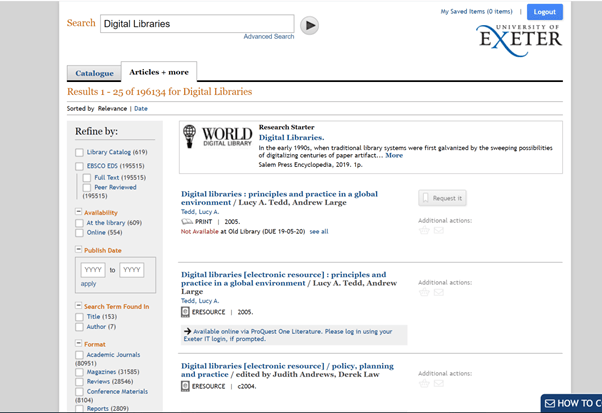
Librarians have the opportunity to use tools that allow them to provide an even quicker, more complete and sometimes more sophisticated service to readers. Databases and reference sources can be queried via the Internet, library catalogues are available remotely, newsgroups and mailing lists provide a wonderful opportunity to discuss mutual concerns quickly, and electronic mail allows them to contact colleagues who might be able to help them solve a problem. And all this can be done within a minimum of time.
In terms of the establishment of business departments, the library has increased the R & D department, service department, and marketing department from traditional interviewing, cataloguing, circulation, reading, reference consulting, information, technology, ancient books and other departments, which greatly expanded the books. The library’s field of work has shifted from the traditional technology and experience of book processing to the acquisition, utilization and development of book knowledge. Employees’ work is more creative and challenging. In addition, for those who are suitable for library work, their professional fields are more extensive. In addition to library professional knowledge, certain discipline knowledge and literature knowledge, theoretical cultivation, foreign language knowledge, computer software and hardware knowledge, network technology, management Professional knowledge in science, statistics, and design is also needed. The structure of knowledge requirements for library work has become richer, more diverse, and more complex.
Possible Changes in the Future
In a sense, much of how libraries develop in the future will depend on how technology itself develops – particularly around the internet and developments in Artificial Intelligence (AI).
The libraries of future will have a structure which not only includes all services and functions, but is supported by artificial intelligence, i.e., the web will be able to analyse information, discuss with other people interested in the same areas, and create new ideas or theories. The AI library will be able to let researchers know information suitable to their research and discussions carried out through the internet or mobile devices even whenever and wherever they are (Younghee Noh, 2015).
Computer technology such as machine learning enables readers to obtain information more efficiently and accurately, which greatly reduces the workload of librarians. However, this does not mean that artificial intelligence can handle all tasks. Some special tasks, such as interoperability agreements between different libraries, and review of articles by contributors, still require specialized personnel to complete.
Word count: 795
References
Besser, Howard (2004). “the Past, Present, and Future of Digital Libraries”. In Schreibman, Susan; Siemens, Ray; Unsworth, John (eds.). A Companion to Digital Humanities. Blackwell Publishing Ltd. pp. 557–575.
Koehler, Amy E. C. (2013). “Some Thoughts on the Meaning of Open Access for University Library Technical Services”. Serials Review. 32 (1): 17–21.
Runqi Yi. (n.d.). In Wikipedia. Retrieved February 14, 2020 from https://en.wikipedia.org/wiki/Digital_library
Younghee Noh. (2015). Imagining Library 4.0: Creating a Model for Future Libraries. Journal of Academic Librarianship, 41(November), 786-797.
 my bolg
Hi, Runqi.
A very good post, which the theme is fitting your undergraduate major. LOL
The digital library in Exeter is convenient and useful. Nowadays, fewer and fewer people read paper books and instead read articles on the Internet so do you think will the paper edition books be eliminated in the future?
赞赞
Hi, Liuyi. Thank you for your post and your thoughts.
A really interesting view, but I do not agree with you. Because physical book has some irreplaceable properties. There is a similar example: remote education system is also very complete, but is cannot replace the offline education.
A digital book is not the same as a physical book-you cannot copy the latter without the great expense of time and money while copying the former takes less than a second. They are no limitations as to how many people can use a digital copy of book. This means that traditional model, in which a writer writes, a publisher publishes and a reader buys and reads does not apply well here. But if the author gets nothing out of the book, what is the motivation for writing a new book?
Although this issue is solved, there are other issues that still prevent physical books from being completely replaced. For example, reading e-books for a long time may cause dizziness, diminution of vision and etc. Many people can not concentrate for a long time when reading e-books.
赞赞
You explain that the introduction of new developments in the fields of arrtificial intelligence and machine learning will change the way we interact with libraries, by facilitating our access to information. Do you think that the librarians themselves will have to completely change their role in the current system, or will the existing collections of texts that have yet to be digitised (which is a long and expensive process) guarantee them a place? That librarians will still have to conduct some aspects of managing a library is evident as you mentioned, for technology cannot replace humans for many decision making roles.
赞Liked by 1 person
Hi, Runqi
Thanks for you share your viewpoint about the changes for librarians, which is professional and thought-provoking. It is my first time to know how the structure of external departments changes because of the digitalisation. I strongly agree with you that the library work will be more challengeable and sophisticated. As when I hosted a Librarian Skill Competition in 2019, I found the contest section is not only testing the ability to catalogue and retrieve, but analysing the data of book flows and reader information. Moreover, recently, the recruitment requirement of librarians in China is “People who study in the relative area (library management & information analysis) will priority to be considered.” that also shown this job has been required more professional. I also think about one negative influence is that we could not be ignored the job loss or low wage of traditional librarians with the growth of AI technology. How to deal with this challenge may need further researches.
赞Liked by 1 person
This was really interesting and obviously very relatable given that we are studying at university. I think your analysis of the potential impact that AI could have on libraries and their functions is incredibly interesting. Especially from a research standpoint, Ben Johnson (2018) talks about this and how conducting research would be much easier with the help of AI.
My question is around the feasibility of implementing a system where AI’s can thrive in libraries. Having studied in Exeter for 4 years now, there have been a lot of times where the relevant book or article is within the University library, but not available online. Do you think that one of the biggest problems with this would be the task of uploading all the relevant information online?
B. Johnson, (2018) Libraries in the Age of Artificial Intelligence, Vol. 38 No. 1
赞Liked by 1 person