
1. Introduction
1.1 Alibaba
In 1999, Ma Yun (also known as Jack Ma) with his 17 friends founded Alibaba based on the technologies of the Internet. In just a few years of its establishment, it has become the world’s largest online and mobile commerce company. Now, the company provides consumer-to-consumer (C2C), business-to-consumer (B2C), and business-to-business (B2B) sales services via web portals, as well as electronic payment services, shopping search engines and cloud computing services (Runqi Yi, n.d.). According to People’s Daily Online the company created over 40 million jobs in 2018 (People’s Daily Online, 2019).
1.2 Digital business model
Constantinou, an adjunct professor at Lund University, claims that digital business models are novel ways to generate demand from new users, new products, new partners and new markets, by practicing techniques first pioneered by Internet companies. But until now there has been no precise definition (Andreas Constantinou, 2020). I think that a digital business model is a form of creating value based on the development of customer benefits using digital technologies.
Geiss describe ten patterns of digital business models: free, freemium, subscription, lock-in, solution provider, rent instead of buy, long tail, user designed, orchestrator and platform business (Michael Geiss, 2018). This study will discuss how digital business model helps Alibaba to succeed from three of them.
2. The way that digital business model affects Alibaba’ s success
2.1 Free pattern
Free pattern entails that a company offers its core product free of charge (Michael Geiss, 2018).
In 1998, China’s trade market was still in the early stage where only information flowed on the Internet. He decided to enter the B2B e-market by providing them with free online services and information according to the different enterprises and the characteristics of the industries (Rashad Yazdanifard, Merveen Tan Hunn Li, 2014).
However, at that time, the cost of Chinese SMEs of doing business with overseas is extremely high due to the special foreign trade environment of China. Up to 2000, this free pattern successfully helped Alibaba owned the users distributed around 185 countries with daily accumulated product posting of 21,976 for buying, 56,823 for selling and 4,387 for cooperation (J. Guo, I. H. Lam, 2006).
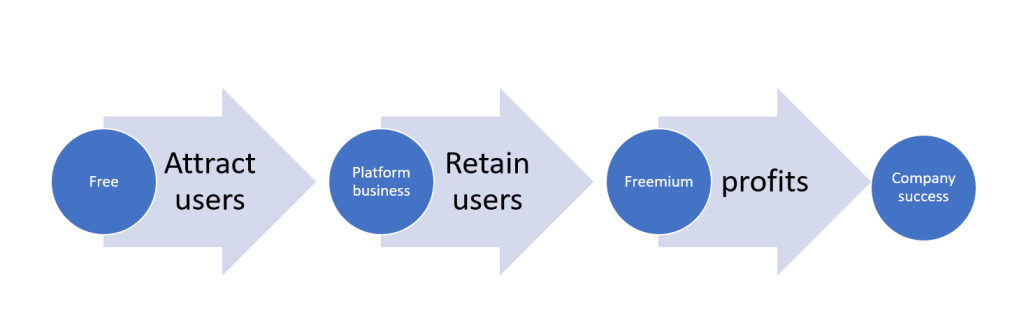
In conclusion, free pattern and solution provider pattern help Alibaba attract users to e-trade market that become the core competency and contributing to more business opportunity in Alibaba.
2.2 platform business pattern
Platform business pattern, here, several different user groups are bought together on one platform to interact with each other (Michael Geiss, 2018).
Alibaba is a virtual platform providing services for customers and customers, businesses and customers, businesses and businesses. In fact, almost all digital enterprises, such as eBay, Amazon and Google, has a platform. There is much emphasis put on improving services that caught the users’ concerned issues. This is evident in the competition between eBay and Alibaba in the Chinese market.
In 2003, with China’s credit card system still incomplete, buyers and sellers are concerned about the security of online payments. Instead of eBay using credit card payment systems, Alibaba launched Alipay in 2004 for making them feel security (Peter Williamson, Michelle MichelleWang Jingji, 2014). This credit system has been very much lessens the risk of e-transactions and ease buyers and sellers concern upon failure of delivery or delivery of fake and damaged products.
By the end of 2005 Taobao had become the undisputed leader in C2C e‐commence in China with a 59% market share (up from 8% in 2003). eBay China’s share plunged from 79% to 36% over the same period. Continued losses and lack of progress in the market finally led eBay to shut down its own site in China in 2006 (Runqi Yi, 2020).
In conclusion, a platform based on improving users’ experience promotes the increasing number of loyal customers or long-term users in Alibaba.
2.3 Freemium pattern
For this pattern, a basic version of the product is offered free of charge; users can then subscribe to a premium version with additional functions.
After a big number of log-term users at Alibaba, it began to charge membership fees. Alibaba earn profits by two major aspects. The primary revenue came from advertising fees from Alibaba. The second source of revenue comes from customers for value-added services, listing fees as well as membership fees. Furthermore, Alipay also began to collect technical service charge from business transaction that take place outside of Taobao and Alibaba (You Fei, 2012).
In conclusion, Alibaba can improve the profitability of company in freemium pattern.
3. Summary
In a word, digital business model allows Alibaba to attract users, retain users, and profits. These three competencies are essential to the success of any company.
Word count: 786
References
Andreas Constantinou. (2020). Digital business models . Retrieved from https://www.coursera.org/learn/digital-business-models/lecture/RdDmg/lesson-3-digital-as-a-business-model
J. Guo, I. H. Lam, I. Lei, X. Guan, P. H. Iong and M. C. Ieong. (2006). “Alibaba International: Building a Global Electronic Marketplace,” 2006 IEEE International Conference on e-Business Engineering (ICEBE’06).
Michael Geiss. (2018, September 28). 10 patterns for successful digital business model innovation [Blog post]. Retrieved from https://iconstorm.com/en/10-patterns-successful-digital-business-model-innovation/
People’s Daily Online. (2019). Alibaba creates over 40 million jobs in 2018: report. Retrieved from http://en.people.cn/n3/2019/0326/c90000-9560830.html
Peter Williamson, Michelle MichelleWang Jingji. (2014). Alibaba group’s Taobao: from intermediary to ecosystem enabler. London, United Kingdom: University of Cambridge, Judge Business School.
Rashad Yazdanifard, Merveen Tan Hunn Li. (2014). The review of Alibaba’s online business marketing strategies which navigate them to present success. Global Journals Inc. (USA).
Runqi Yi. (n.d). Retrieved from https://en.wikipedia.org/wiki/Alibaba_Group
Runqi Yi. (2020). Within 2 years Taobao had far outstripped eBay’s market share in China and by 2010 eBay’s market share was down to 7% compared with Taobao’s 85%. Retrieved from https://www.chinadecoded.com/2010/10/27/shark-in-a-river-how-taobao-beat-ebay-in-china/
You Fei, J. (2012). E-marketing strategic management at Alibaba.com. De Monfort University. MBA Library.
 my bolg
Hello, Roxtonyi
Thank you for demonstrating how Alibaba’s business model succeed from 3 dimensions with clear structure.
Interestingly that I have chosen the same topic as yours for this blog, and I have read articles that illustrates challenges Alibaba faces: with the rapid development of other platform based corporations and Alibaba expanding globally, do you care to share a thought of whether Alibaba’s digital business model will continue to maintain its competitive advantages facing the fierce competition, for example, Amazon?
With respect,
Daria
赞Liked by 1 person